A cricket scorecard becomes readable once you separate the headline score from the individual figures. For example, 142/6 after 17.4 overs means 142 team runs, six wickets lost and 17 completed overs plus four legal balls. Then use batting rows to see who scored, bowling rows to see who conceded runs and took wickets, and extras to reconcile the total.
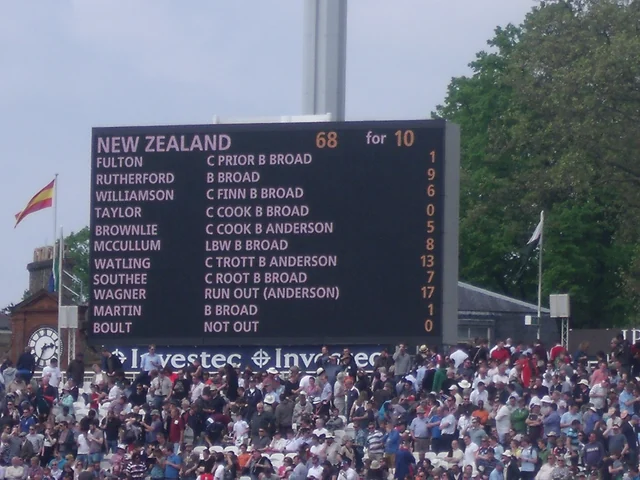
Archival cricket photograph · source and credits
How to read the headline score
A score written as 142/6 tells you the batting side has made 142 runs and lost six wickets. A scorecard may also show the overs beside it, such as 142/6 in 17.4 overs. The first number is the team total, the number after the slash is wickets lost, and the overs show how many legal deliveries have been used.
Read the innings header for the teams, innings order and any revised overs limit. In a chase, the figures describe progress towards a target; they do not by themselves say whether the side will win.
- MCC Law 3: The Scorershttps://www.lords.org/mcc/the-laws/the-scorers
- ICC Playing Conditions hubhttps://www.icc-cricket.com/about/cricket/rules-and-regulations/playing-conditions
Runs: team total, batter runs and extras
The team total is the sum of runs credited to batters and extras. Runs from a shot are credited to the striker, while extras are recorded separately. Common extras are wides, no-balls, byes, leg byes and, where the applicable conditions provide for them, penalty runs. On a no-ball, any bat runs belong to the striker while the no-ball penalty remains an extra; wide and no-ball extras are not batter runs. This is why the leading batter's score will not necessarily add up to the team's total.
A bye is scored when a delivered ball that is not called Wide passes the striker without touching bat or person. A leg bye is possible after the ball strikes the striker's person when the umpire is satisfied that the batter tried to play the ball or avoid being hit. Byes and leg byes are not charged to the bowler, unlike wides and no-ball extras.
- MCC Law 18: Scoring Runshttps://lawsofcricket.lords.org/laws-of-cricket/the-over-scoring-runs-dead-ball-and-extras/scoring-runs
- MCC Law 23: Bye and Leg Byehttps://lawsofcricket.lords.org/laws-of-cricket/the-over-scoring-runs-dead-ball-and-extras/bye-and-leg-bye
- MCC Law 22: Wide Ballhttps://lawsofcricket.lords.org/laws-of-cricket/the-over-scoring-runs-dead-ball-and-extras/wide-ball
- MCC Law 21: No Ballhttps://lawsofcricket.lords.org/laws-of-cricket/the-over-scoring-runs-dead-ball-and-extras/no-ball
Overs: read the notation as balls, not decimals
Under the Laws, an over contains six valid balls. A no-ball or wide does not count as one of those six, so the bowler delivers another ball before the over is complete. Therefore 17.4 means 17 complete overs and four legal balls, or 106 legal balls, not 17.4 decimal overs.
In an uninterrupted men's T20 international, each side has a maximum of 20 overs unless dismissed earlier, and one bowler may deliver no more than four overs. Interrupted matches can have revised limits, but a revised overs quota and a DLS target or result are separate questions: the applicable competition's playing conditions specify the minimum overs needed for a result and any earlier-result exceptions. A short scorecard alone cannot establish a target or winner. A live score one run below a target is not by itself a tie; under those conditions, a DLS tie requires an eligible innings to end at par.
- MCC Law 17: The Overhttps://lawsofcricket.lords.org/laws-of-cricket/the-over-scoring-runs-dead-ball-and-extras/the-over
- MCC Law 21: No Ballhttps://lawsofcricket.lords.org/laws-of-cricket/the-over-scoring-runs-dead-ball-and-extras/no-ball
- MCC Law 22: Wide Ballhttps://lawsofcricket.lords.org/laws-of-cricket/the-over-scoring-runs-dead-ball-and-extras/wide-ball
- ICC Men's T20I Playing Conditions, October 2026https://images.icc-cricket.com/image/upload/prd/bsxcho7ufe2pjban0wjp.pdf
Batting figures: what each row tells you
A batting row commonly shows the batter's name, runs, balls faced, boundaries and strike rate. A line such as Asha 54 (38) means 54 runs from 38 balls in that innings. The dismissal text explains how the innings ended, such as caught, bowled, lbw, run out or stumped. An unbeaten batter is marked not out, often with an asterisk.
Strike rate is a comparison of runs with balls faced: runs divided by balls, multiplied by 100. It helps describe scoring speed, but it should be read with the format and match situation. A batter's runs exclude extras, so use the extras line and the other batting rows to reconcile the team total.
- MCC Law 18: Scoring Runshttps://lawsofcricket.lords.org/laws-of-cricket/the-over-scoring-runs-dead-ball-and-extras/scoring-runs
- MCC Law 3: The Scorershttps://www.lords.org/mcc/the-laws/the-scorers
- BCCI Playing Conditionshttps://www.bcci.tv/playing-condition
Bowling figures: overs, maidens, runs and wickets
Bowling figures are usually displayed as O-M-R-W: overs bowled, maidens, runs conceded and wickets. Thus 4-0-28-2 means four completed overs, no maiden overs, 28 runs conceded and two wickets. A maiden is conventionally a completed over in which the bowler concedes no runs according to that competition's scorecard; the applicable scoring or playing conditions govern how any penalty runs are treated.
The bowling total is not simply the batter totals. The bowler is charged with runs scored by the striker, plus no-ball extras and wides. Byes and leg byes are recorded as extras but do not inflate the bowler's runs. Economy rate is runs conceded per six legal balls: runs conceded × 6 ÷ legal balls bowled. For an unfinished notation such as 3.2 overs, use 20 legal balls rather than treating 3.2 as decimal overs.
- MCC Law 18: Scoring Runshttps://lawsofcricket.lords.org/laws-of-cricket/the-over-scoring-runs-dead-ball-and-extras/scoring-runs
- MCC Law 23: Bye and Leg Byehttps://lawsofcricket.lords.org/laws-of-cricket/the-over-scoring-runs-dead-ball-and-extras/bye-and-leg-bye
- ICC Playing Conditions hubhttps://www.icc-cricket.com/about/cricket/rules-and-regulations/playing-conditions
Wickets and innings status
The wickets figure counts dismissals credited against the batting side, not the number of catches. One wicket can be bowled, caught, lbw, run out, stumped or recorded under another dismissal law. The fall-of-wicket list adds context by showing the score and batter at each dismissal.
An innings can finish because the prescribed overs have been bowled or because the side is all out. It can also end when no further batter is available, including circumstances covered by the playing conditions. That is why the innings status and competition rules matter more than assuming every innings lasts its full overs.
- MCC Law 17: The Overhttps://lawsofcricket.lords.org/laws-of-cricket/the-over-scoring-runs-dead-ball-and-extras/the-over
- ICC Men's T20I Playing Conditions, October 2026https://images.icc-cricket.com/image/upload/prd/bsxcho7ufe2pjban0wjp.pdf
- MCC Law 3: The Scorershttps://www.lords.org/mcc/the-laws/the-scorers
Worked hypothetical scorecard example
Hypothetical example, not a match result: Team Blue 142/6 after 17.4 overs. The headline says Blue has 142 runs, six wickets down and 106 legal balls used. The batting section might show Asha 54 from 38 balls, Ben 31 from 24 and other batters supplying the remaining runs. If extras are 7, the batter-run subtotal is 135.
The bowling line Rehan 3.2-0-26-2 means Rehan has bowled 20 legal balls, conceded 26 runs and taken two wickets; using the legal-ball formula, that is an economy rate of 26 × 6 ÷ 20 = 7.8. The 7 extras do not automatically belong to Rehan: byes and leg byes are excluded from his figures, while wides and no-ball extras are included. Check the extras breakdown if totals do not match.
- MCC Law 17: The Overhttps://lawsofcricket.lords.org/laws-of-cricket/the-over-scoring-runs-dead-ball-and-extras/the-over
- MCC Law 18: Scoring Runshttps://lawsofcricket.lords.org/laws-of-cricket/the-over-scoring-runs-dead-ball-and-extras/scoring-runs
- ICC Men's T20I Playing Conditions, October 2026https://images.icc-cricket.com/image/upload/prd/bsxcho7ufe2pjban0wjp.pdf
Why the competition rules still matter
MCC Laws provide the foundation, but a tournament's playing conditions can modify format details. The ICC publishes separate Test, ODI and T20I documents. Its 1 October 2026 announcement identifies the effective date for the cited changes, including the ODI/T20I wide-ball provision that uses the batter's leg position at delivery as the reference even if the batter later moves. For a real scorecard, use the version applicable to the match date.
Domestic boards and leagues publish their own conditions too. BCCI separates international and domestic downloads, while the IPL maintains its own official match area. If an innings was shortened or a competition has a special provision, read that match's conditions before interpreting an unusual figure.
- ICC Playing Conditions hubhttps://www.icc-cricket.com/about/cricket/rules-and-regulations/playing-conditions
- ICC: Key changes across formats, 1 October 2026https://www.icc-cricket.com/news/key-changes-across-formats-with-new-icc-playing-conditions
- BCCI Playing Conditionshttps://www.bcci.tv/playing-condition
- Official IPL Matcheshttps://www.iplt20.com/matches
Questions readers ask
Does 17.4 overs mean 17.4 minutes or decimal overs?
No. It means 17 complete six-ball overs plus four legal balls. A no-ball or wide does not use one of the six legal-ball places.
Why can a team score more runs than its batters add up to?
Extras such as wides, no-balls, byes, leg byes and penalty runs belong to the team total but are recorded separately from batter runs. Bat runs made from a no-ball are still credited to the striker, while the no-ball penalty is an extra.
Why are some bowler figures lower than the team total?
The team total includes every batter run and extra. A bowler is not charged with byes or leg byes, although wides and no-ball extras are charged to the bowler; for economy, use runs conceded × 6 ÷ legal balls bowled.