A useful pitch report separates fixed facts from uncertain forecasts. Start with the venue and format, confirm the pitch dimensions, then assess grass, hardness, moisture, wear and likely bounce. Add dew point and match timing, but treat them as changing influences rather than promises. The safest reading is a range of possible behaviours, not a guaranteed result.
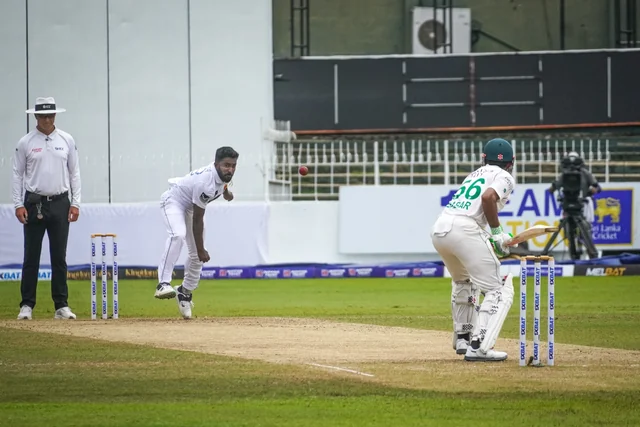
Archival cricket photograph · source and credits
What a pitch report is really telling you
A venue report describes conditions that may influence how the ball behaves. It is not a score prediction. A good report tells you what was observed, what may change during the match and which uncertainties still matter, such as weather, covers, timing and the quality of the first few overs.
Read it in layers. First identify the ground, format and match start time. Then separate hard facts from interpretation, such as a claim that the pitch should slow down. The same adjective can mean different things in a Test, one-day match or T20, so the applicable playing conditions must be checked for that competition.
- ICC Playing Conditionshttps://www.icc-cricket.com/about/cricket/rules-and-regulations/playing-conditions
- IPL official pitch reporthttps://www.iplt20.com/videos/s-m58-pbks-vs-rcb-pitch-report-9u9m1e
Dimensions: fixed pitch, variable venue
Under MCC Law 6, the standard pitch is 22 yards, or 20.12 metres, long and 10 feet, or 3.05 metres, wide. That describes the strip between the creases, not the whole square or outfield. Treat venue size and shape as separate context when assessing boundaries and fielding positions; do not fold those considerations into the pitch dimensions.
The law makes clear who controls the surface: the ground authority selects and prepares it before the match, while the umpires control its use and maintenance during play. A 2011 BCCI IPL advisory illustrates that competition-specific distinction; it should not be exported as a universal rule for every tournament.
- MCC Law 6: The Pitchhttps://lawsofcricket.lords.org/laws-of-cricket/setting-up-the-game/the-pitch
- BCCI: No team has choice of wickethttps://www.bcci.tv/news/article/no-team-has-choice-of-wicket
Turn surface words into ball behaviour
Grass is not automatically a green light for seam bowling. Dense, coarse or uneven grass can make the ball deviate, while thin or patchy cover can produce inconsistent pace and bounce. A hard, even surface may offer reliable carry, but can play differently if soil underneath remains damp or the pitch has been used repeatedly.
When a report says seam, bounce, pace or turn, ask what mechanism is being described. Seam means deviation after the ball lands; bounce concerns how high and consistently it rises; pace is how quickly it reaches the batter; turn is sideways movement after pitching. Dryness, abrasion and a breaking surface can help spin, but no single word decides the contest.
- New Zealand Cricket pitch preparation guidehttps://www.nzc.nz/media/10212/nzc_pitch-prep_pages_digital_1608.pdf
- ICC Pitch and Outfield Ratingshttps://www.icc-cricket.com/about/cricket/rules-and-regulations/pitch-ratings
Dew: use the forecast, not the cliché
Dew forms when a surface cools to the dew point, allowing water vapour to condense. Dew point is more informative than relative humidity alone because it measures how much moisture is in the air; a high dew point means more moisture is available. Grass and calm conditions can encourage dew when the surface cools to or below the dew point, but a forecast cannot guarantee that the match surface will become equally wet.
For cricket, check when dew is expected, whether the pitch is covered, wind strength, surface temperature and how quickly the ball and outfield can be dried. Moisture may alter surface grip and ball handling, yet the effect is not a universal second-innings advantage. Treat dew as a timing and handling variable, not a rule of toss strategy.
- National Weather Service: Dew Point vs Humidityhttps://www.weather.gov/arx/why_dewpoint_vs_humidity
- UK Met Office: Dewhttps://weather.metoffice.gov.uk/learn-about/weather/types-of-weather/temperature/dew
A worked hypothetical reading
Hypothetical example: a report describes a natural pitch with a firm surface, light and even grass cover, and a calm evening with a high dew point. It says the square has hosted recent matches. A careful reader would infer a reasonable chance of consistent early bounce, while allowing for wear later and dew to affect ball handling after sunset.
That is deliberately a range, not a verdict. The report does not prove that the pitch will be fast, that spin will dominate later or that chasing will be easier. The opening overs, actual moisture, ball condition and the umpires' decisions provide new evidence. Update the assessment instead of defending the first label.
- New Zealand Cricket pitch preparation guidehttps://www.nzc.nz/media/10212/nzc_pitch-prep_pages_digital_1608.pdf
- National Weather Service: Dew Point vs Humidityhttps://www.weather.gov/arx/why_dewpoint_vs_humidity
- UK Met Office: Dewhttps://weather.metoffice.gov.uk/learn-about/weather/types-of-weather/temperature/dew
Why prediction has a hard limit
A pitch is a physical surface, but a match is a moving system. Covers can change moisture, sunlight can dry one section, footmarks can develop, and balls can behave differently. A venue's previous reputation is useful context, not evidence that the selected strip will behave identically.
Official ratings also show why labels need care. The ICC assesses international pitches and outfields after matches through the match referee, feeding the rating back to the host board. That is retrospective evaluation, not a promise made before play. The best report therefore states observations, gives conditional possibilities and names what would change the view.
- ICC Pitch and Outfield Ratingshttps://www.icc-cricket.com/about/cricket/rules-and-regulations/pitch-ratings
- ICC Playing Conditionshttps://www.icc-cricket.com/about/cricket/rules-and-regulations/playing-conditions
A beginner's quick checklist
Before trusting a report, ask six questions: Which format and competition rules apply? What is being measured—the pitch, square or outfield? Is the surface hard, soft, cracked, grassy, dusty or merely described that way? Is moisture on the surface or underneath? When will temperature and dew change? Which claims are observations, and which are forecasts?
If a report cannot answer all six, that is not a failure. It is a signal to keep the conclusion modest. Use the report to understand possible match patterns and to follow the game more intelligently, never as certainty about a result.
- MCC Law 6: The Pitchhttps://lawsofcricket.lords.org/laws-of-cricket/setting-up-the-game/the-pitch
- ICC Playing Conditionshttps://www.icc-cricket.com/about/cricket/rules-and-regulations/playing-conditions
- New Zealand Cricket pitch preparation guidehttps://www.nzc.nz/media/10212/nzc_pitch-prep_pages_digital_1608.pdf
Questions readers ask
Is a green pitch always better for fast bowlers?
No. Grass density, surface hardness, moisture and consistency matter more than colour alone. Dense or coarse grass can assist deviation, while a hard, even pitch may offer predictable bounce without much seam movement.
Does dew always make the team batting second stronger?
No. Dew can affect grip and handling, but its timing and intensity vary with surface temperature, wind, cloud, covers and local conditions. It is a possibility to monitor, not a guaranteed advantage.
Can a venue's past pitch reputation predict a particular match?
It can provide context, but not certainty. Preparation, recent use, weather, covers and the exact strip selected can change how the surface plays. Read the latest available observations before relying on historical labels.