When rain reduces a limited-overs match, Duckworth-Lewis-Stern (DLS) recalculates the chase from the scoring resources left to each side, including overs and wickets. A revised target is the whole-number score needed to win. If a chase is stopped permanently after the competition's applicable minimum qualifying opportunity is met, officials compare the chasing score with the DLS par score; otherwise it is generally a No Result unless an earlier result applies. The minimum opportunity and no-result threshold are set by the competition, so an ODI, T20I, World Cup or league can differ.
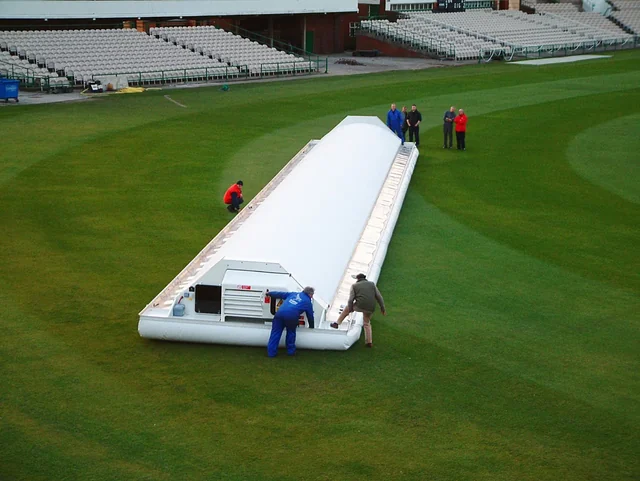
Archival cricket photograph · source and credits
What DLS is designed to do
DLS is the Duckworth-Lewis-Stern method used to reset a target when weather or another interruption removes playing time. It treats an innings as a pool of scoring resources: overs still available and wickets still in hand. A simple run-rate calculation is not enough because 10 overs with nine wickets left differs from 10 overs with six wickets down.
The ICC says resources are not directly proportional to overs alone. Officials use the current calculator with the score, wickets, overs or balls remaining and each interruption. Treat the official scorer's number as authoritative rather than reproducing it from an old table or average run rate.
- ICC Duckworth-Lewis-Stern overviewhttps://www.icc-cricket.com/about/cricket/rules-and-regulations/duckworth-lewis-stern
- ICC DLS Methodologyhttps://images.icc-cricket.com/image/upload/prd/orlbya4cqyhqaceje3b2.pdf
Revised target and par score are not the same
A revised target is the score the team batting second must reach to win after its overs are recalculated. Under the October 2026 ICC men's ODI and T20I conditions cited here, it is a whole number. If play ends at one run below the target, that score is a tie under the applicable conditions; while the chase continues, it is simply one run short. A target of 126 means 126 wins; 125 is not already a tie while play continues.
A par score is used when the chase stops permanently under the applicable playing conditions after the required qualifying opportunity has been met. It is the DLS score at the exact suspension, without the extra run that makes a target. Above par wins, level with par ties, and below par gives victory to the side batting first; if the qualifying opportunity is not met and no earlier result applies, the match is a No Result.
- ICC Men's ODI Playing Conditions, October 2026https://images.icc-cricket.com/image/upload/prd/bxkzkcyvfn6tvi70zh0w.pdf
- ICC Men's T20I Playing Conditions, October 2026https://images.icc-cricket.com/image/upload/prd/bsxcho7ufe2pjban0wjp.pdf
- ICC DLS Methodologyhttps://images.icc-cricket.com/image/upload/prd/orlbya4cqyhqaceje3b2.pdf
How rain changes a chase
If rain interrupts the first innings, the first team may receive fewer overs and the second team gets a target based on both sides' resources. If rain interrupts the chase, its innings can be shortened again. DLS is recalculated after each relevant interruption, so the scoreboard target can change more than once.
Wickets matter because a side that has lost wickets has fewer resources than an unbeaten side with the same overs left. DLS estimates a fair scoring comparison for that match state; it does not judge which team played better in the abstract.
- ICC DLS Methodologyhttps://images.icc-cricket.com/image/upload/prd/orlbya4cqyhqaceje3b2.pdf
- ICC Duckworth-Lewis-Stern overviewhttps://www.icc-cricket.com/about/cricket/rules-and-regulations/duckworth-lewis-stern
Worked hypothetical examples
Hypothetical example: Team A makes 160. Rain reduces Team B's chase, and DLS sets a target of 126. Team B wins by reaching 126. If play ends at 125, the result is a tie under the applicable conditions; while play continues, 125 is simply one run short. This is an illustration only, not a real result or a substitute for the official calculator.
Hypothetical example: after the applicable qualifying opportunity has been met, Team B is 95 for 3 when rain ends the match. The officials' par score is 92. Team B wins above par; 92 would tie if play ends at par, and 91 would give Team A the win. The number 92 is hypothetical and depends on the exact match state.
- ICC Men's ODI Playing Conditions, October 2026https://images.icc-cricket.com/image/upload/prd/bxkzkcyvfn6tvi70zh0w.pdf
- ICC Men's T20I Playing Conditions, October 2026https://images.icc-cricket.com/image/upload/prd/bsxcho7ufe2pjban0wjp.pdf
When a rain-hit match becomes a no-result
A revised target is not enough to make a match official. Under the October 2026 ICC men's ODI conditions cited here, a DLS result normally requires the team batting second to have the minimum qualifying opportunity specified by the conditions—20 overs; the October 2026 ICC men's T20I conditions normally specify five overs. Those thresholds do not prevent an earlier result when the chase reaches its target or the innings ends under the relevant conditions, and the competition can set a different minimum. If neither an earlier result nor the applicable minimum opportunity exists, the match is a No Result rather than a DLS win or loss.
The rule is competition-specific. The cited ICC Men’s T20 World Cup 2026 conditions require 10 overs in the semi-finals and final, not the standard five; check the event document before applying a generic threshold. Read an abandonment or no-result report with the event's conditions, and check whether an earlier completed result applies, rather than relying on a generic rain rule.
- ICC Men's ODI Playing Conditions, October 2026https://images.icc-cricket.com/image/upload/prd/bxkzkcyvfn6tvi70zh0w.pdf
- ICC Men's T20I Playing Conditions, October 2026https://images.icc-cricket.com/image/upload/prd/bsxcho7ufe2pjban0wjp.pdf
- ICC Men's T20 World Cup 2026 Playing Conditionshttps://images.icc-cricket.com/image/upload/prd/igqt8cceiusrtat0ru5u.pdf
Why the competition rulebook matters
MCC writes and interprets the Laws, but notes that competitions can apply playing regulations that differ from them. ICC publishes separate format and event conditions. Domestic boards and leagues can do the same. BCCI lists separate ODI, T20 and domestic documents, while an IPL match centre labels an actual result as decided by the DLS Method.
For a live match, check the event's conditions and the official scorecard or broadcast graphic. Look for revised overs, target, current par score and the minimum overs for a result. Do not infer a result from rain alone or confuse a tie at par with a no-result match.
- MCC, The Laws of Crickethttps://www.lords.org/mcc/about-the-laws-of-cricket
- icc-cricket.com · Why the competition rulebook mattershttps://www.icc-cricket.com/about/cricket/rules-and-regulations/playing-conditions
- BCCI Playing Conditionshttps://www.bcci.tv/playing-condition
- IPL official match centre, LSG v RCB, 7 May 2026https://www.iplt20.com/matches/fad46a8a-29dc-40bf-bc09-bbe753af7118/lucknow-super-giants-vs-royal-challengers-bengaluru
Questions readers ask
Is DLS the same as a reduced-overs target?
No. Reduced overs describe the new innings length. DLS also uses wickets and the match state to calculate the target or par score.
What happens if the chasing team is exactly on the par score when rain ends play?
Only when play has ended and the applicable qualifying opportunity has been met: under the cited ICC ODI and T20I conditions, a chasing score equal to par is tied. A live score one run below a target is not yet a tie because the chase can continue. A competition's own conditions decide whether a Super Over is used.
Can a T20 match have a DLS result after only four overs?
Usually not under the standard ICC men's T20I conditions: the team batting second must have the specified minimum qualifying opportunity, normally five overs, unless the conditions allow an earlier completed result such as reaching the target or completing the innings. An event can set a different requirement; the cited ICC Men’s T20 World Cup 2026 conditions use 10 overs in the semi-finals and final.