A T20 total is a result, not a diagnosis. Read it in phases: the powerplay shows how well a side used fielding restrictions, the middle overs show whether it built or lost control, and the death overs show how it finished. Then add wickets, extras, the target and match conditions. The same total can describe a calm chase, a late recovery or a collapse followed by hitting.
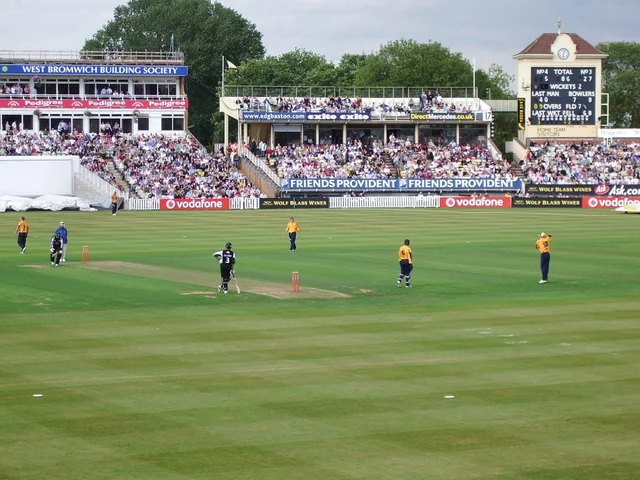
Archival cricket photograph · source and credits
Start with the score's shape, not just its size
A score such as 182 for 7 tells you runs and wickets, but not when the runs came or whether a late surge hid a middle-over struggle. Split the innings into phases, then read each phase alongside wickets, extras and the match situation.
For men's international series beginning on or after 1 October 2026, the ICC Men's T20I conditions effective October 2026 make the first six overs of a full 20-over innings the Powerplay. An ongoing series may remain under earlier conditions, and domestic or league matches can differ. For this guide, we use the common shorthand middle overs (7–15) and death overs (16–20) in a full innings; these are analysis labels, not separate MCC Laws.
- ICC Men's T20I Playing Conditions, effective October 2026https://images.icc-cricket.com/image/upload/prd/bsxcho7ufe2pjban0wjp.pdf
- MCC: About the Laws of Crickethttps://www.lords.org/mcc/about-the-laws-of-cricket
Powerplay: opportunity with a price
For men's international series beginning on or after 1 October 2026, the ICC Men's T20I conditions effective October 2026 allow only two fielders outside the marked fielding-restriction area at the instant of delivery during the Powerplay of a full-length innings. After the Powerplay, no more than five may be outside. Ongoing series, domestic or league matches, and reduced innings may use different conditions, so the applicable competition rulebook controls.
A strong Powerplay score is not simply the highest number. Ask how many wickets it cost, how many runs came from extras rather than the bat, and whether the batters faced the best new-ball bowling. A moderate score with both openers in can offer more control than a bigger score with key wickets gone.
- ICC Men's T20I Playing Conditions, effective October 2026https://images.icc-cricket.com/image/upload/prd/bsxcho7ufe2pjban0wjp.pdf
Middle overs: where an innings reveals its plan
In the full-innings shorthand used here, the middle overs are 7–15. Under the ICC Men's T20I conditions effective October 2026, for men's international series beginning on or after 1 October 2026, up to five fielders may be outside the restriction area after the Powerplay. Captains can therefore protect more boundary zones, while batters often respond with strike rotation, match-ups and selective attacks. The applicable competition conditions may differ.
A quiet middle phase is not automatically poor if wickets are preserved. Conversely, a respectable rate can hide accumulating dot balls or lost set batters. Ask whether singles built pressure or too much work was left for the finish.
- ICC Men's T20I Playing Conditions, effective October 2026https://images.icc-cricket.com/image/upload/prd/bsxcho7ufe2pjban0wjp.pdf
Death overs: finish, risk and remaining resources
The death overs are the common full-innings shorthand for overs 16–20. The Powerplay restriction has ended, so the fielding side can protect more boundary zones. Batters seek value through placement, running and calculated boundary attempts while bowlers make clean contact difficult. These phase labels do not override the applicable competition conditions in a reduced or differently regulated match.
A big death-over number can be excellent finishing or recovery from an earlier collapse. A low number can reflect skilled bowling, a difficult pitch or wickets falling. Check who was available, whether the innings ended early and whether the target demanded risk.
- ICC Men's T20I Playing Conditions, effective October 2026https://images.icc-cricket.com/image/upload/prd/bsxcho7ufe2pjban0wjp.pdf
Worked hypothetical: one total, two stories
Hypothetical example only: Team A finishes on 202 for 6, split as 59 for 1 in the Powerplay, 68 for 2 in the middle overs and 75 for 3 at the death. Team B also makes 202 for 6, but its split is 44 for 0, 101 for 2 and 57 for 4. The totals and wicket counts match, yet the innings feel different.
Team A used the opening field and finished strongly, but lost wickets late. Team B built a middle-overs base, then lost momentum and wickets. If conditions were alike, Team A suggests a more even distribution of pressure; Team B suggests a platform not converted cleanly. The chase, extras and dismissals still matter.
Five checks that stop a bad reading
Use five grouped checks: (1) wickets lost and batters available; (2) extras versus runs from the bat; (3) the target and required rate; (4) legal balls and balls remaining; and (5) pitch, weather and bowling quality. Then ask whether the innings was shortened or affected by a slow-over-rate penalty. These details prevent a phase score from being mistaken for a verdict.
When comparing rates, use legal balls: runs × 6 ÷ legal balls. Wides and no-balls do not add legal balls, and extras should not be treated as bat-runs when judging batting output. For men's international series beginning on or after 1 October 2026, the ICC baseline caps a full innings at 20 overs and a bowler at four overs; ongoing series, domestic or league matches, and reduced innings may use other limits. For rain- or interruption-reduced matches, use the applicable competition or DLS playing conditions, including their minimum-over requirements and stated exceptions; do not infer a full-match phase comparison from the nominal over count.
- ICC Men's T20I Playing Conditions, effective October 2026https://images.icc-cricket.com/image/upload/prd/bsxcho7ufe2pjban0wjp.pdf
Why the same scorecard symbols need context
A notation such as 10.5 overs means ten completed overs plus five valid balls, or 65 legal balls, not 10.5 decimal overs. Under MCC Law 17, an over has six valid balls; a no-ball or wide does not count. That is why an over can require extra deliveries and extras can change the score without using a valid ball. Use legal balls—not decimal-over arithmetic—when calculating a rate or required rate.
Competition regulations can modify the baseline Laws. MCC says its Laws are not a substitute for tournament conditions. The ICC Men's T20I conditions listed here are effective October 2026 for men's international series beginning on or after 1 October 2026; ongoing series may use earlier conditions. BCCI lists separate documents, and IPL maintains a Match Playing Conditions page. Use the relevant rulebook for an unusual score.
- MCC Laws of Cricket, 2017 Code 4th Edition 2026https://www.lords.org/getattachment/8c96a135-beff-4a46-b5c6-2a02a7245386/Laws-of-Cricket-2017-Code-4th-Edition-(2026).pdf
- MCC: About the Laws of Crickethttps://www.lords.org/mcc/about-the-laws-of-cricket
- ICC Playing Conditions indexhttps://www.icc-cricket.com/about/cricket/rules-and-regulations/playing-conditions
- BCCI Playing Conditionshttps://www.bcci.tv/playing-condition
- IPL Match Playing Conditionshttps://www.iplt20.com/playing-conditions
Questions readers ask
Is a higher Powerplay score always better?
No. Compare the runs with wickets, extras versus bat-runs, and the quality of bowling faced. A slightly lower score with both openers available may leave a side better placed than a higher score that has already lost key batters.
Does every T20 competition use the same Powerplay?
No. For men's international series beginning on or after 1 October 2026, the ICC Men's T20I baseline uses six Powerplay overs with two fielders outside in a full innings, followed by no more than five outside. An ongoing series may use earlier conditions, while shortened matches and domestic or tournament regulations can differ. Check the applicable playing conditions.
Can an over be recorded with fewer or more than six legal balls?
In ordinary play, an over is completed after six valid balls under MCC Law 17; wides and no-balls are not valid balls, so the over continues. An umpire's miscount can nevertheless stand under Law 17.5, even if the over was allowed to continue beyond six valid balls. The notation 10.5 means ten overs and five valid balls, not a decimal fraction.