The Ranji Trophy is an Indian domestic two-innings competition played between state teams. Under the cited BCCI Men’s Multi-day Playing Conditions 2025-26, an outright win is worth six points, a first-innings lead without an outright win is worth three, and the team behind on first innings receives one. The BCCI’s 2026-27 ready reckoner lists 32 Elite teams in four groups, with the top two from each group entering the quarter-finals; a separate six-team Plate group sends its top two to a Plate final. The cited 2025-26 points table should not be treated as the confirmed 2026-27 points or interruption rules unless the applicable 2026-27 playing conditions say the same.
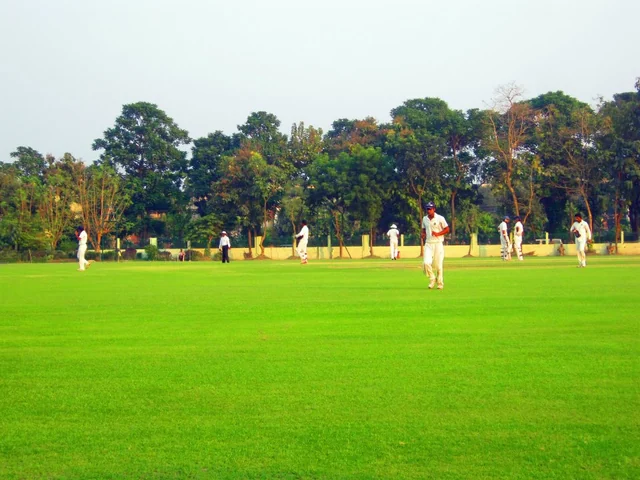
Archival cricket photograph · source and credits
What makes a Ranji Trophy match first-class
The Ranji Trophy is an Indian domestic two-innings competition played between state teams. ICC classification defines a first-class match as a contest between two sides of 11 players, with two innings per side, of three or more days’ duration, on a natural-turf pitch and substantially conforming to the applicable conditions. ICC specifically includes Ranji matches between Indian states. The game is therefore built around time and wickets, not a fixed number of overs.
In a normal two-innings match, teams bat in alternating innings. A captain can declare, and the side batting first can enforce the follow-on when its lead reaches 200 runs in a match of five days or more. The follow-on is an option, not an automatic punishment.
- ICC Classification of Official Cricket, effective March 2024https://images.icc-cricket.com/image/upload/prd/ilr4nwhuw3yt0a0vt0by.pdf
- MCC Law 13: Inningshttps://lawsofcricket.lords.org/laws-of-cricket/innings-and-results/innings
- MCC Law 14: The Follow-onhttps://lawsofcricket.lords.org/laws-of-cricket/innings-and-results/the-follow-on
- BCCI Men’s Multi-day Playing Conditions 2025-26https://www.bcci.tv/cms/files/gtykgr9m2ngt/4W7p83Hnj6t5QFyfiEqFQ8/4314cd20c7459f870d71476a7c303b1e/1772193467492_2025-26_BCCI_Men_Multi_Day_PC.pdf
What a first-innings lead means
A first-innings lead is simply the difference between the teams’ first completed innings. If Team A makes 420 and Team B makes 280, Team A leads by 140 runs. That lead is not the same as a match win: both sides may still have a second innings, and the match can finish drawn because time runs out.
This distinction explains many Ranji scorecards. A team can lead after the first innings yet draw because time runs out. The lead still affects the league table, while an outright win depends on the combined two-innings result.
- MCC Law 13: Inningshttps://lawsofcricket.lords.org/laws-of-cricket/innings-and-results/innings
- MCC Law 16: The Resulthttps://lawsofcricket.lords.org/laws-of-cricket/innings-and-results/the-result
- BCCI Men’s Multi-day Playing Conditions 2025-26https://www.bcci.tv/cms/files/gtykgr9m2ngt/4W7p83Hnj6t5QFyfiEqFQ8/4314cd20c7459f870d71476a7c303b1e/1772193467492_2025-26_BCCI_Men_Multi_Day_PC.pdf
Ranji Trophy league points explained
Under the BCCI Men’s Multi-day Playing Conditions 2025-26, the published men’s multi-day league table awards six points for an outright win. An innings win or a win by 10 wickets adds one bonus point. A first-innings lead without an outright win is worth three points, while the side that loses on first innings receives one point. An outright loss brings zero points. For a 2026-27 match, the applicable 2026-27 playing conditions control; the supplied source set does not include a separate 2026-27 points table.
The same cited table lists separate outcomes for close or interrupted matches. A tie on first innings without an outright result gives one point to each side. A tie on both innings gives three points each. It also lists one point each where no first-innings result is achieved. Those figures are subject to the 2025-26 competition’s interruption provisions; they should not be generalized to every shortened or abandoned match, and no 2026-27 interruption rule is asserted here. These are competition points, not a conversion of the runs scored.
- BCCI Men’s Multi-day Playing Conditions 2025-26https://www.bcci.tv/cms/files/gtykgr9m2ngt/4W7p83Hnj6t5QFyfiEqFQ8/4314cd20c7459f870d71476a7c303b1e/1772193467492_2025-26_BCCI_Men_Multi_Day_PC.pdf
A worked hypothetical points example
Hypothetical example under the cited 2025-26 table: Team North scores 360 and Team South 250 in the first innings, so North leads by 110. If the match is drawn, North receives three points and South one. If North later wins outright, North receives six points instead; an innings win or a win by 10 wickets makes it seven with the bonus.
A second hypothetical shows why interruption wording matters. If rain prevents a first-innings result and the applicable 2025-26 interruption provisions classify the match under the table’s no-result outcome, both teams receive one point. A delayed or abandoned match is not automatically a first-innings win.
- BCCI Men’s Multi-day Playing Conditions 2025-26https://www.bcci.tv/cms/files/gtykgr9m2ngt/4W7p83Hnj6t5QFyfiEqFQ8/4314cd20c7459f870d71476a7c303b1e/1772193467492_2025-26_BCCI_Men_Multi_Day_PC.pdf
The 2026-27 Elite and Plate structure
For the 2026-27 season, the BCCI ready reckoner lists 32 Elite teams arranged in four groups, labelled A to D, plus a six-team Plate group. The top two teams in each Elite group qualify directly for the Elite quarter-finals. The published bracket is A1 versus C2, B1 versus D2, C1 versus A2, and D1 versus B2.
The semi-final bracket then pairs the winners of QF1 and QF4, and the winners of QF2 and QF3. The two semi-final winners meet in the final. In the Plate competition, the top two teams in the six-team group play the Plate final. This is the current published 2026-27 structure, so it should not be confused with older Elite-Plate or zonal formats.
- BCCI 2026-27 Domestic Season Ready Reckonerhttps://www.bcci.tv/cms/files/gtykgr9m2ngt/47hIqSlxrlq1Nmwd8Li91C/cc21af622113baa330abe52430d2dd4d/1779273276961_BCCI_2026-27_Domestic_Season_Ready_Reckoner.pdf
How to read the table and the knockout caveat
During the league phase, compare points first, then consult the tournament’s published ranking criteria for any tie. The 2026-27 ready reckoner describes Elite grouping using points, bonus points, wins, head-to-head where applicable and quotient. That is a grouping rule, not a universal live-match tie-break.
League points do not carry a team through a knockout by themselves. The ready reckoner defines the quarter-final bracket, while BCCI says knockout qualification is circulated separately for each tournament. For a drawn or tied knockout, use that season’s specific conditions and official result rather than assume an old first-innings rule applies.
- BCCI 2026-27 Domestic Season Ready Reckonerhttps://www.bcci.tv/cms/files/gtykgr9m2ngt/47hIqSlxrlq1Nmwd8Li91C/cc21af622113baa330abe52430d2dd4d/1779273276961_BCCI_2026-27_Domestic_Season_Ready_Reckoner.pdf
- BCCI Men’s Multi-day Playing Conditions 2025-26https://www.bcci.tv/cms/files/gtykgr9m2ngt/4W7p83Hnj6t5QFyfiEqFQ8/4314cd20c7459f870d71476a7c303b1e/1772193467492_2025-26_BCCI_Men_Multi_Day_PC.pdf
Questions readers ask
Does a first-innings lead mean the team has won the Ranji match?
No. It means that team scored more in the first innings. If the match is drawn, the leader gets three league points under the cited 2025-26 table, but an outright win requires the overall two-innings result.
How many points does a Ranji Trophy outright win give?
Under the published 2025-26 men’s multi-day league table, an outright win gives six points. An innings win or a win by 10 wickets adds one bonus point, making seven. The applicable 2026-27 playing conditions may govern the 2026-27 season instead.
How many teams qualify for the 2026-27 Ranji Elite quarter-finals?
Eight: the top two from each of the four Elite groups. The BCCI bracket is A1-C2, B1-D2, C1-A2 and D1-B2. The separate Plate group sends its top two teams to a Plate final.