Women’s cricket uses the same language of runs, wickets, overs and extras, but Tests, ODIs and T20Is are not interchangeable. A women’s Test gives each side two innings over four or five scheduled days; an ODI gives each side up to 50 overs; a T20I gives each side up to 20. Read the format and competition conditions before interpreting a scorecard.
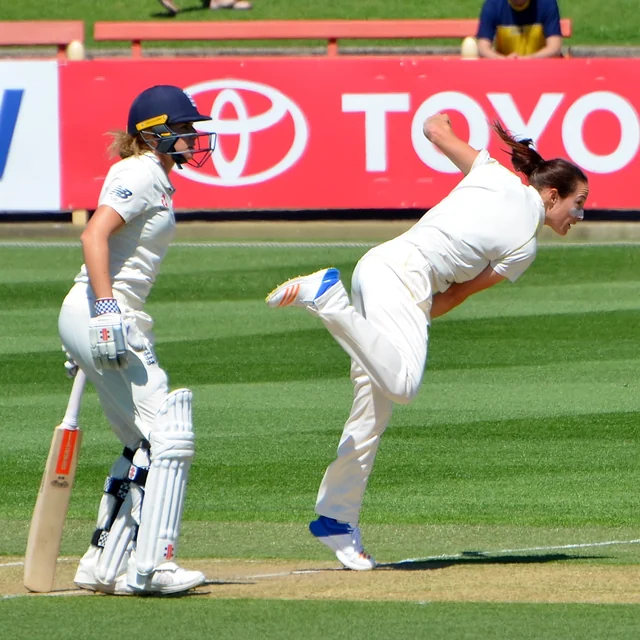
Archival cricket photograph · source and credits
The short answer: identify the format first
At international level, the three formats are Test matches, One-Day Internationals and Twenty20 Internationals. Their scorecards share familiar columns, but the match shape changes what a number means. A Test has two innings per side; an ODI and T20I normally have one. Tests are time-based, while ODIs and T20Is are limited by overs.
The format label is the first line to check, followed by the competition’s own playing conditions. A score of 150 may be one Test innings, but a complete T20I team total.
- ICC, The Three Formats of Crickethttps://www.icc-cricket.com/about/cricket/game-formats/the-three-formats
- ICC, Playing Conditions indexhttps://www.icc-cricket.com/about/cricket/rules-and-regulations/playing-conditions
Women’s Tests: two innings, time and declarations
ICC women’s Test conditions effective from October 2026 (checked 11 October 2026) allow four or five scheduled days. Each side has two innings unless a result is reached earlier. A captain may declare when the ball is dead, except in the final innings, so a scorecard can show a declaration rather than ten wickets. A Test can be drawn; it can be tied when all innings finish with equal scores.
The follow-on is Test-specific. The side batting first may enforce it after a lead of at least 200 runs in a five-day Test or 150 in a four-day Test. Hypothetical scorecard: Team A 284 declared and 167 all out; Team B 190 and 262 not out for nine, giving B 452 against A’s 451 and a one-wicket win. This example is invented; read each innings separately.
- ICC Women’s Test Match Playing Conditions, October 2026https://images.icc-cricket.com/image/upload/prd/hbwwi78pugzpdwft0v4v.pdf
- MCC Law 17, The Overhttps://lawsofcricket.lords.org/laws-of-cricket/the-over-scoring-runs-dead-ball-and-extras/the-over
Women’s ODIs: 50 overs, bowling quotas and Powerplay
In an uninterrupted women’s ODI, each team bats for 50 overs unless all out earlier. No bowler may bowl more than 10 overs. ICC conditions effective for series beginning on or after 1 October 2026 apply a 10-over Powerplay: no more than two fielders may be outside the restriction area in overs 1 to 10, and no more than four outside during non-Powerplay overs. The normal innings interval is 30 minutes, with an uninterrupted-match range of 30 to 45 minutes allowed by the conditions.
Hypothetical scorecard: Team A 276 for 7 in 50 overs; Team B 278 for 8 in 49.4 overs, winning by two wickets. The 49.4 means 49 completed overs plus four valid balls, not decimal overs. In a rain- or interruption-affected match, the applicable competition conditions may revise the target and bowling limits under the designated method; minimum-overs requirements and any named exceptions determine whether a revised result is possible, so check the dated playing conditions and scorecard context. A DLS-type tie requires an eligible innings to end at the applicable par score; a live score one run below a target is not, by itself, a tie.
- ICC Women’s ODI Playing Conditions, October 2026https://images.icc-cricket.com/image/upload/prd/qunpw1kfh3ibxlz58jlw.pdf
- ICC, Playing Conditions indexhttps://www.icc-cricket.com/about/cricket/rules-and-regulations/playing-conditions
Women’s T20Is: 20 overs and a shorter tactical window
In an uninterrupted women’s T20I, each team bats for 20 overs unless all out earlier. A bowler may deliver no more than four overs. The Powerplay is the first six overs, with only two fielders outside the restriction area; during non-Powerplay overs, no more than four may be outside. The standard interval is 15 minutes, reducible to not less than 10 minutes when time has been lost.
Hypothetical scorecard: Team A 142 for 6 in 20 overs; Team B 143 for 5 in 19.3 overs, winning by five wickets. The 19.3 means 19 overs and three valid balls, not a decimal. A tie may use the Super Over procedure in the applicable conditions.
- ICC Women’s T20I Playing Conditions, October 2026https://images.icc-cricket.com/image/upload/prd/o3vhm0zw7pppoxpgopke.pdf
- icc-cricket.com · Women’s T20Is: 20 overs and a shorter tactical windowhttps://www.icc-cricket.com/news/key-changes-across-formats-with-new-icc-playing-conditions
How to read the scorecard without mixing rules
First read the innings header. Test scorecards separate first and second innings; ODI and T20I cards usually show one innings per team. Overs use cricket notation: six valid balls make an over, while a no-ball or wide does not count as one of those six. A total such as 142 for 6 includes batter runs and extras; the extras line shows wides, no-balls, byes and leg-byes. The one-run no-ball or wide penalty is an extra, while bat runs off a no-ball are recorded separately; byes and leg-byes are extras rather than bat runs. A bye is not charged to the bowler, and a maiden-over claim depends on the competition’s scoring conditions.
Do not treat a Powerplay, bowler limit, drinks break or tie-break method as universal. Interrupted-match targets require the designated calculation method and the scorecard’s revised-overs context, and minimum-overs/result requirements plus any named exceptions must be met before a revised result can be recorded.
- MCC Law 17, The Overhttps://lawsofcricket.lords.org/laws-of-cricket/the-over-scoring-runs-dead-ball-and-extras/the-over
- MCC Law 21, No Ballhttps://lawsofcricket.lords.org/laws-of-cricket/the-over-scoring-runs-dead-ball-and-extras/no-ball
- MCC Law 22, Wide Ballhttps://lawsofcricket.lords.org/laws-of-cricket/the-over-scoring-runs-dead-ball-and-extras/wide-ball
Why the competition rulebook still matters
The format name is not the whole rulebook. For ICC international series beginning on or after 1 October 2026, the ICC’s updated men’s and women’s playing conditions apply; ongoing series continue under earlier regulations. The ICC lists women’s Test, ODI and T20I documents separately. BCCI likewise lists separate women’s international and domestic multi-day, one-day and T20 conditions.
League rules can add procedures. The IPL’s 2025 advisory, for example, allowed one wet-ball replacement after the 10th over and expanded some DRS reviews. That is an IPL example, not an international women’s rule. Use the governing body’s conditions effective for the relevant competition and date.
- icc-cricket.com · Women’s T20Is: 20 overs and a shorter tactical windowhttps://www.icc-cricket.com/news/key-changes-across-formats-with-new-icc-playing-conditions
- BCCI, Playing Conditionshttps://www.bcci.tv/playing-condition
- IPL, Match Playing Conditionshttps://www.iplt20.com/playing-conditions
- IPL, Updates and changes following IPL Captains Meetinghttps://www.iplt20.com/news/article/updates-and-changes-following-ipl-captains-meeting
Questions readers ask
Does every women’s match use 50 overs?
No. A women’s ODI normally allows 50 overs, a T20I 20, and a Test two innings per side over four or five scheduled days. Domestic and league conditions can vary.
What does 19.3 mean on a scorecard?
It means 19 completed six-ball overs plus three valid balls. It is cricket notation, not decimal overs. Wides and no-balls do not count as valid balls.
Can I compare a Test total with an ODI or T20 total?
Only with context. A Test total may be one of two innings, while an ODI or T20 total is usually the only innings. Check format, overs, wickets and interruptions.